The Tantrums Are Real
Nobody tells you. Not your mom, not your friends, not those smug parenting blogs with their pastel aesthetics and stock photos of blissful families at the farmer’s market. They all smile mysteriously and say things like “Oh, the toddler phase is such a journey,” as if they’re hinting at some beautiful spiritual awakening rather than the psychological warfare that’s about to unfold in your living room.
I’m here to tell you: the tantrums are absolutely, completely, undeniably real.
The Sneaker Phase
It starts small. Innocuously. Your kid is two, almost three, and mostly reasonable. Then one day, one day, you make the catastrophic mistake of suggesting that today, we wear the blue shirt instead of the red one.
Cue the meltdown heard round the neighborhood.
I’m talking full-body collapse. Not a gentle cry. We’re talking about a child who has suddenly discovered that their body is a musical instrument of rage, and they’re going to play a solo that would make a death metal band weep. The blue shirt? A personal attack. Your suggestion? Betrayal. Your very existence? A crime against humanity.
And here’s the thing nobody prepared me for: there’s no reasoning with it. You cannot logic your way out of a toddler tantrum. I once tried to explain to my three-year-old that the laws of physics prevent two socks from being worn on the same foot. She responded by screaming so hard she turned a shade of purple I’m pretty sure isn’t in the official Pantone color system.
The Public Humiliation Guarantee
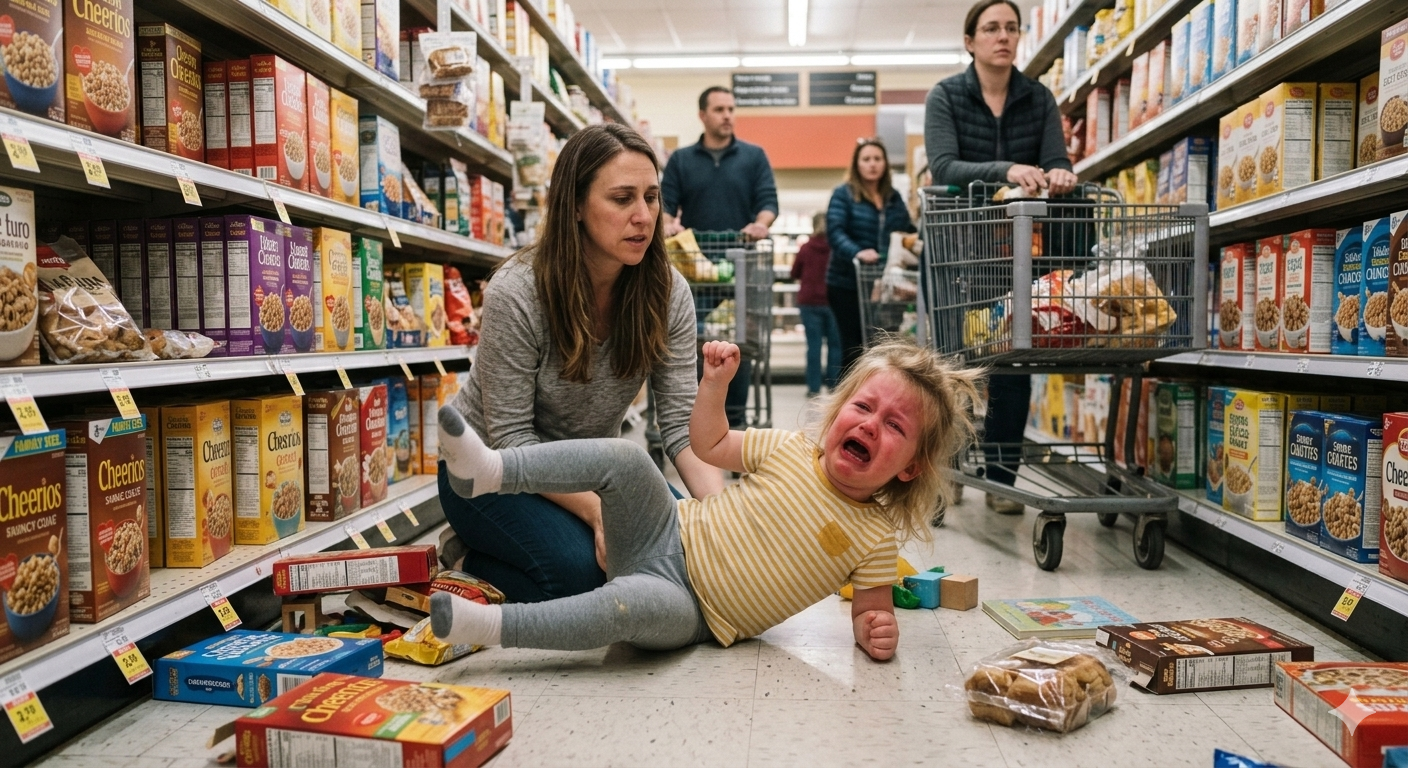
The tantrums at home? That’s just practice. The real performance happens at the grocery store.
There’s something about fluorescent lighting and a captive audience that brings out the Shakespeare in a tantrum. My kid will be fine, genuinely fine, until we walk past the bakery section. Then, for reasons known only to the universe and her toddler brain, she decides that this is the moment. This is when she must collapse dramatically across the floor tiles and keen like a banshee because I refused to buy seventeen boxes of the overpriced sugar cereals.
And every parent in that aisle is looking at you. Not with judgment, exactly. It’s more like recognition. They see you. They’ve been you. They know you’re doing everything right and it’s still ending with your child’s body going completely limp like a sack of potatoes while she makes sounds that seem physically impossible for a human under four feet tall.
The worst part? I can feel the grandmas mentally rating my response. Am I staying calm? Am I being too firm? Not firm enough? Did I deserve this by being a bad parent, or am I simply the unfortunate victim of biology? The silent pressure is immense.
The Logic of the Unreasonable
What kills me, what absolutely wrecks me, is trying to decode what caused any given tantrum.
Blue shirt instead of red: Legitimate crisis.
Cutting sandwich diagonally instead of in half: Grounds for a 45-minute wail.
I once got rained on during an outdoor activity. My child, concerned for my wellbeing? No. Upset that the rain was preventing further playground time? Absolutely. The fact that she was getting rained on too? Irrelevant. My suffering was the real problem here.
Yesterday, my daughter had a complete meltdown because I ate a grape from her snack cup. Not her grape. Just a grape that existed in the same container. The violation was immense. The betrayal, apparently, generational.
I’ve learned that there is no point trying to explain consequences or fairness or the concept of sharing during these moments. You cannot bring logic to a feelings party. It’s like trying to win an argument with a hurricane. The hurricane doesn’t care about your reasoning. It only cares about destruction and noise.
The Weird Part: When They’re Over
Here’s what nobody tells you that I’m telling you now: the weirdest part is how fast they end.
One moment, your child is on the floor of Checkers, having what appears to be an existential crisis over being told they can only have one toy. They’re inconsolable. Snot is involved. The volume is apocalyptic. You’re genuinely wondering if this is just their personality now and you’ll be managing this meltdown for the next fifteen years.
Then, five minutes later, it’s over. Gone. They’re offering you a hug, asking for snacks, ready to move on with their life like the previous ten minutes of sonic chaos didn’t happen.
Meanwhile, you’re still in the hole. You’re still processing. You’re still stressed. Your nervous system is still running on emergency power. But your child? They’ve completely forgotten and are now cheerfully asking if you can go look at the ducks.
The unfairness of this emotional recovery disparity is something I’m still working through in therapy.
The Truth They Don’t Tell You
Here’s what I wish someone had said to me, clearly and directly, before I had kids:
The tantrums are real. They are loud. They are unpredictable. They are not your fault, and you’re not doing anything wrong. Your child isn’t broken. You’re not broken. This is just what tiny humans do when their brains are too small to manage their feelings.
It’s temporary. It gets better. (Or it changes into different problems, which might actually be worse, but we’ll cross that bridge when we get there.)
And in the meantime? You’re doing great. The fact that you’re surviving it, that you’re showing up, staying (mostly) sane, and not abandoning your kid at the store, is a massive win.
Now if you’ll excuse me, I need to go negotiate with a three-year-old about why bedtime is not, in fact, a suggestion.
The tantrums are real. But so are you.
And that’s enough.